
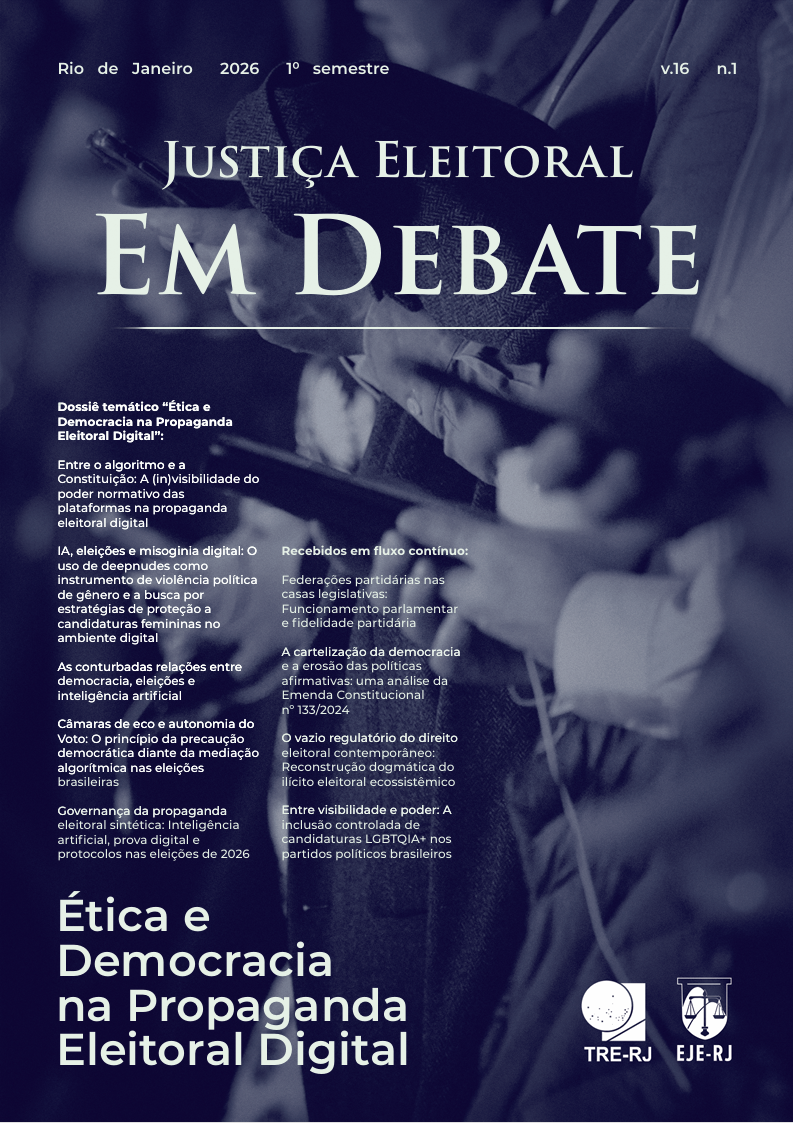
As Conturbadas Relações Entre Democracia, Eleições e Inteligência Artificial
DOI:
https://doi.org/10.71381/c0hk7q82Palabras clave:
Inteligência Artificial – Eleições – DemocraciaResumen
O presente texto analisa as complexas relações entre democracia, eleições e inteligência artificial (IA), destacando como o avanço tecnológico vem transformando os processos políticos contemporâneos. Sustenta que, enquanto a IA pode oferecer ferramentas úteis para análise de dados, comunicação política e ampliação do engajamento cívico, ela também cria riscos significativos para a integridade democrática. Entre esses riscos estão a disseminação de desinformação, o uso de deepfakes, a manipulação da opinião pública por algoritmos e a formação de bolhas informacionais nas redes sociais. O trabalho ressalta o crescente poder das grandes plataformas digitais e a dificuldade de controle estatal sobre seus sistemas algorítmicos. Além disso, discute experiências internacionais e iniciativas regulatórias, bem como normas eleitorais brasileiras, que buscam garantir transparência, responsabilidade e proteção aos direitos fundamentais.
Referencias
ACCOTO, Cosimo. Il mondo ex machina. Cinque brevi lezioni di filosofia dell’automazione. Milano: Egea, 2019.
BATOOL, Amna, ZOWGHI, Didar & BANO, Muneera. AI governance: a systematic literature review. In AI Ethics, nº5, 3265–3279 (2025).
BONTCHEVA, Kalina (a cura di). Generative AI and disinformation: recent advances, challenges, and opportunities. Publicado pelo European Digital Media Observatory, em 13/02/2024, pp. 4-5, disponível no site: https://edmo.eu/wp-content/uploads/2023/12/Generative-AI-and-Disinformation_-White-Paper-v8.pdf, em 24/09/2025.
BONTCHEVA, Kalina (ed.). Generative AI and disinformation: recent advances, challenges and opportunities. In https://edmo.eu/wp-content/uploads/2023/12/Generative-AI-and-Disinformation_-White-Paper-v8.pdf, acesso em 13/08/2025.
BORRELLO, Roberto. Alcune riflessioni preliminari (e provvisorie) sui rapporti tra motori di ricerca ed il pluralismo informativo. In MediaLaws, 1, 2017, 68-78, acesso pelo site: https://www.medialaws.eu/rivista/alcune-riflessioni-preliminari-e-provvisorie-sui-rapporti-tra-i-motori-di-ricerca-ed-il-pluralismo-informativo/, em 25/02/2026.
CADWALLADR, Carole. Google, democracy and the truth about internet search. In The Guardian, 04/12/2016, acesso pelo site: https://www.theguardian.com/technology/2016/dec/04/google-democracy-truth-internet-search-facebook, em 25/02/2026.
CALO, Ryan. Artificial intelligence policy: a primer and roadmap. Acesso pelo site: https://lawreview.law.ucdavis.edu/sites/g/files/dgvnsk15026/files/media/documents/51-2_Calo.pdf, em 04/03/2026.
CASONATO, Carlo e MARCHETTI, Barbara. Prime osservazioni sulla proposta di regolamento dell’Unione Europea in materia di intelligenza artificiale. In Biolaw Journal – Rivista de BioDiritto, nº3, 2021.
COLE, Brendan. AI candidate promising 'fair and balanced' reign attracts thousands of votes in tokyo mayoral election, em 19/04/2018, disponível no site: https://www.newsweek.com/ai-candidate-promising-fair-and-balanced-reign-attracts-thousands-votes-tokyo-892274, acesso em 20/08/2025.
DANAHER, John. Rule by Algorithm? Big data and the threat of algocracy. In https://philosophicaldisquisitions.blogspot.com/2014/01/rule-by-algorithm-big-data-and-threat.html, acesso em 06/08/2025.
EUROPEAN COMMISSION. A multi-dimensional approach to disinformation – report of the independente high level group on fake news and online disinformation. Luxembourg: Publications Office of the European Union, 2018.
EUROPEAN PARLIAMENT. The Impact of General Data Protection Regulation (GDPR) on artificial intelligence. In European Parliamentary Research Service, Scientific Foreign Unit (STOA), PE 641.530, 2020, acesso pelo site: https://www.europarl.europa.eu/RegData/etudes/STUD/2020/641530/EPRS_STU(2020)641530_EN.pdf, em 06/08/2025.
FERRAJOLI, Luigi. La democrazia costituzionale. In Journal for Constitutional Theory and Philosophy of Law, nº18, 2012.
FRASER, Nancy. Rethinking the public sphere: a contribution to the critique of actually existing democracy. In CALHOUN, Craig. Habermas and the Public Sphere. Boston: MIT, 1992.
FUNK, Aline; SHAHBAZ, Aline and VESTEINSSON, Kian. Freedom on the Net 2023: the repressive power of artificial intelligence. Acesso pelo site: https://freedomhouse.org/report/freedom-net/2023/repressive-power-artificial-intelligence, em 24/09/2025.
GURUMURTHY, Anita and BHARTHUR, Deepti. Democracy and the algorithmic turn. In SUR Review, v.15, nº27, 2018.
HARARI, Yuval Noah. 21 lessons for the 21st century. New York: Spiegel&Grau, 2018.
----. Why does technology favor tyranny? In https://telegrafi.com/en/why-technology-favors-tyranny/, acesso em 06/08/2025.
HELBING, Dirk. Machine intelligence: blessing or curse? It depends on Us! In HELBING, Dirk. Towards digital enlightenment – essays on the dark and light sides of the digital revolution. New York: Springer, 2019.
HOLROYD, Matthew. Deepfake Zelenskyy surrender video is the first intentionally used in Ukraine war. In Euronews, 16/032022, acesso pelo site: https://www.euronews.com/my-europe/2022/03/16/deepfake-zelenskyy-surrender-video-is-the-first-intentionally-used-in-ukraine-war, em 24/09/2025.
HOSANAGAR, Kartik. A human’s guide to machine intelligence: how algorithms are shaping our lives and how we can stay in control. New York: Viking, 2019.
https://artificialintelligenceact.eu/ai-act-explorer/, em 06/08/2025.
https://data.govt.nz/docs/algorithm-assessment-report, acesso em 20/08/2025.
https://democracyinnovators.com/michihito-matsuda-about-the-ai-mayor-project-and-why-we-need-to-overcome-old-democratic-systems/ , acesso em 20/08/2025.
https://digital-strategy.ec.europa.eu/pt/policies/ai-office?utm_source, acesso em 03/09/2025.
https://eur-lex.europa.eu/legal-content/PT/TXT/PDF/?uri=OJ%3AL_202401689, em 04/06/2025.
https://hudoc.echr.coe.int, em 24/09/2025.
https://hudoc.echr.coe.int/eng#{%22itemid%22:[%22001-119244%22]}, em 04/03/2026.
https://leadership4ir.com/2018/04/19/ai-candidate-runs-for-mayor-in-japan/, acesso em 20/08/2025.
https://liedekerke.com/en/insights/artificial-intelligence-and-legal-personality?utm_source, acesso em 04/03/2026.
https://today.yougov.com/technology/articles/46058-majorities-americans-are-concerned-about-spread-ai, acesso em 04/06/2025.
https://www.congress.gov/bill/117th-congress/senate-bill/3572?utm_source, acesso em 03/09/2025.
https://www.digital.govt.nz/showcase/sam-meet-your-politician-of-the-future? , acesso em 20/08/2025.
https://www.frontiersin.org/journals/communication/articles/10.3389/fcomm.2020.00054/, acesso em 04/06/2025.
https://www.reuters.com/technology/generative-ai-faces-major-test-indonesia-holds-largest-election-since-boom-2024-02-08/, acesso em 04/06/2025.
https://www.theguardian.com/us-news/2024/jan/22/biden-fake-robocalls-new-hampshire, acesso em 04/06/2025.
https://www.tse.jus.br/comunicacao/noticias/2026/Fevereiro/eleicoes-2026-tse-aprova-sete-resolucoes-que-vigorarao-no-pleito, em 04/03/2026.
https://www.wired.com/story/openai-tech-giants-us-government-ai-projects/, acesso em 04/06/2025.
https://www3.weforum.org/docs/WEF_The_Global_Risks_Report_2024.pdf, em 04/06/2025.
INNERARITY, Daniel. El impacto de la inteligencia artificial en la democracia. In Revista de las Cortes Generales, nº109, segundo semestre (2020), pp.87/103. Madrid: Congreso de los Diputados, 2020.
JONSSON, Oscar & TENA, Carlos Luca de. European tech insights- mapping european attitudes towards technological change and its governance, 2019, acesso pelo site: https://docs.ie.edu/cgc/IE-CGC-European-Tech-Insights-2021.pdf, em 20/08/2025.
KNILL, Christoph. The study of morality policy: analytical implications from a public policy perspective. In Journal of European Public Policy, nº20, 2013.
KOVACEVIC, Ana V. Disinformation and generative AI. In https://www.researchgate.net/publication/389396573_Disinformationa_and_Generative_AI, acesso em 13/08/2025.
KUSCHE, Isabel. Possible harms of artificial intelligence and the EU AI act: fundamental rights and risk. In Journal of Risk Research. May 11,2024. Routledge, 2024.
LEAL, Rogério Gesta. Déficits democráticos na Sociedade de Riscos e (des)caminhos dos protagonismos institucionais no Brasil. São Paulo: Tirant lo Blanch, 2020.
----. Propaganda eleitoral e as ameaças à democracia. Porto Alegre: TJRS, 2025.
MCCARTHY, John. What is artificial intelligence? Stanford: Stanford University, 2007. Acesso pelo site: https://www-formal.stanford.edu/jmc/whatisai.pdf, em 06/08/2025.
NEMITZ, Paul. Constitutional democracy and technology in the age of artificial intelligence. In Philosophical Transactions Review, A376, november, 28, 2018.
NILSSON, Nils J. The quest for artificial intlligence – a history of ideas and achievements. New York: Cambridge University Press, 2010.
PAWELEC, Maria. Deepfakes and democracy (theory): how synthetic áudio-visual media for disinformation and hate speech threaten core democratic funcitons. In Digital Society (2022), 1:19, september/2022.
PIRRO, Andre L. P. The contemporary far right from contra to control. In Political Communication, 41(6), pp.1017/1022, 2024.
POECHHACKER, Nikolaus. Democratic algorithms: ethnography of a public recommender system. Lüneburg: Meson Press, 2024.
POLLICINO, Oreste (edit.). Freedom of speech and the regulation of fake news. Cambridge: Intersentia, 2023.
POLLICINO, Oreste e DUNN, Piero. Intelligenza artificiale e democrazia. Opportunità e rischi di disinformazione e discriminazione. Roma: Bocconi University Press, 2024.
QAMAR, Roheen and ZARDARI, Baqar Ali. Artificial neural networks: an overview. In Mesopotamian Journal of Computer Science, v.34. (2023).
REBELO, Karen. India’s generative AI election pilot shows artificial intelligence in campaings is here to stay. Publicado pelo Center for Media Engagement, da University of Texas at Austin. Acesso pelo site: https://mediaengagement.org/wp-content/uploads/2024/10/Indias-Generative-AI-Election-Pilot-Shows-Artificial-Intelligence-In-Campaigns-Is-Here-To-Stay.pdf, em 13/08/2025.
SUCIU, Peter. Is Russia’s invasion of Ukraine - the firs social media war? In Forbes, 01/03/2022, acesso pelo site: https://www.forbes.com/sites/petersuciu/2022/03/01/is-russias-invasion-of-ukraine-the-first-social-media-war/, em 24/09/2025.
SUNSTEIN, Cass R. #Republic.com – la democrazia nell’epoca dei social media. Bologna: Il Mulino, 2017.
THE ECONOMIST. The global democracy index: how did countries perform in 2024? Edition 26,02.2025, p.12. Acesso pelo site: https://www.economist.com/interactive/democracy-index-2024? , em 04/06/2025.
URBINATI, Nadia. Democracy disfigured: opinion, truth and the people. New York: Harvard University Press, 2014.
VÁZQUEZ, Juan Manuel. Digital services taxes in the European Union: what can we expect? Publicado em 14/02/2023, no site: https://legalblogs.wolterskluwer.com/international-tax-law-blog/digital-services-taxes-in-the-european-union-what-can-we-expect/?utm_source=chatgpt.com, acesso em 04/03/2026.
WIRTZ, Bernd W.; WEYERER, Jan C. & GEYER, Carolin. (2018): Artificial iIntelligence and the public sector—applications and challenges. In International Journal of Public Administration, edition 24/07/2018. New York: Routledge, 2018.
Descargas
Publicado
Número
Sección
Licencia
Derechos de autor 2026 Revista Justiça Eleitoral em Debate

Esta obra está bajo una licencia internacional Creative Commons Atribución 4.0.